Federal Retirement Planning Workbook
A practical workbook for organizing your retirement income picture across FERS, TSP, Social Security, military retirement, brokerage accounts, and other income sources.
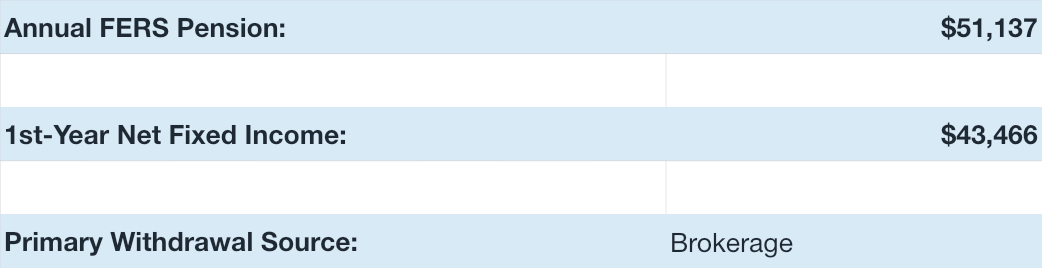
Actual workbook sample
- Annual FERS Pension:
- $51,137
- 1st-Year Net Fixed Income:
- $43,466
- Primary Withdrawal Source:
- Brokerage
What the workbook helps you organize
Retirement dashboard
Summarize expected income sources and estimated monthly retirement cash flow.
FERS pension estimate
Use your projected high-3 salary, service, and applicable multiplier for a rough planning estimate.
TSP and account growth
Model balances, contributions, assumed growth, and potential retirement funding.
Scenario comparison
Review how different retirement dates and assumptions may change the outcome.
Other income sources
Add Social Security, military retirement, brokerage income, pensions, rentals, and other sources.
Income-gap view
Compare expected retirement cash flow with your desired monthly income.
Software and planning assumptions
Software: Downloadable .xlsx files intended for desktop Microsoft Excel. Reviewed outputs were checked in Apple Numbers 14.3 and a calculation engine; execution in Microsoft Excel itself remains unverified. Google Sheets compatibility is not promised. Preview images are rendered workbook samples, not Excel application screenshots.
Supported scope: Regular FERS planning estimates. Special-category retirement, disability retirement, CSRS, military service deposits, and FEHB/FEGLI eligibility are outside the supported calculations. Military retired pay and VA benefits can be entered as income; the planner does not determine entitlement.
Main planner: Uses whole ages, annual periods and a 2026 base year. Retirement-age accumulation is included in the opening retirement balance. It is not an exact midyear separation or pay-period model. Near-term retirees may need to enter a known expected high-3. Future contribution limits stay at editable 2026 amounts; pension COLA is an annual approximation starting no earlier than modeled age 62. Returns and withdrawal rates are assumptions, not guarantees.